
You could call DevOps a business strategy these days, not merely an engineering decision.
The reason is simple: software is the operating system of modern commerce.
From product launches and the customer experience to your supply chain, finances, and internal processes, you are relying on software to be both dependable and agile. And still, some organizations put DevOps in the box of a technical matter for the engineering team to handle.
Today, a well-thought-out DevOps business strategy has an impact that goes well beyond the next software release. It is what allows an organization to put down risk, scale up, act on growth
and make quick work of market shifts. You will see companies with that kind of strategic capability outpace their rivals without sacrificing stability.
We don’t need to debate if DevOps is good for engineering any longer. The question now is what it does for the bottom line.
Why DevOps Has Moved Beyond Engineering
DevOps is no longer just an engineering concern; it started out as a way to address a technical one.
Development teams built software. and the operations side tending to the infrastructure. The problem was in the handoff; it was a source of friction that would all too often lead to deployment failures or simply slow things down.
But the nature of the business has evolved.
What changed is the role software now plays in business.
These days software is at the heart of how you make money and keep customers. So the pace of delivery has real consequences for the bottom line.
Putting off a release is not merely a technical matter; it is ceding ground to the competition, risking customer retention, and missing what the market will have.
That is the reason why many companies have come to see DevOps as an element of their overall business strategy, not something that is confined to the engineering department.
The Business Benefits of DevOps
The most significant business benefits of DevOps extend beyond deployment frequency and infrastructure management.
Organizations that invest in mature DevOps capabilities often experience improvements across multiple business functions.
| Business Challenge | DevOps Impact |
| Slow product releases | Faster software delivery |
| Rising operational costs | Increased automation and efficiency |
| Service disruptions | Improved reliability and monitoring |
| Difficulty scaling | Standardised deployment processes |
| Delayed innovation | Faster experimentation and feedback |
The value comes from creating a repeatable delivery model that supports growth without introducing unnecessary complexity.
Businesses gain the ability to move quickly while maintaining control.
DevOps Culture Creates Organisational Alignment
Technology challenges often appear technical on the surface but are frequently rooted in organizational structure.
- Teams operate in silos.
- Priorities become misaligned.
- Ownership becomes unclear.
The solution to these problems is a strong DevOps culture that promotes joint accountability across development, operations, security, and product teams.
DevOps isn’t about seeing software delivery as a series of functions but about collaborating to deliver shared outcomes.
Why is that important? It’s important due to the increased number of stakeholders involved in the software delivery process.
Engineering may build the product, but customer success, operations, compliance, product management, and executive leadership all depend on successful execution.
Why DevOps Matters for Enterprises
Large organizations face a distinct set of challenges compared to smaller companies.
Legacy systems, complex infrastructure, regulatory requirements, and multiple development teams can make change difficult.
This is where DevOps for enterprises becomes relevant.
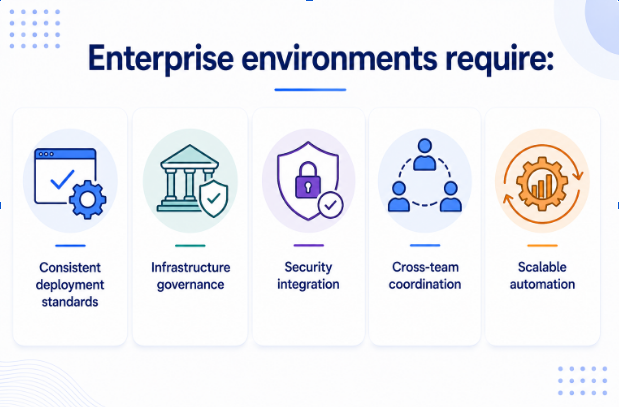
Enterprise environments require:
- Consistent deployment standards
- Infrastructure governance
- Security integration
- Cross-team coordination
- Scalable automation
Without these capabilities, software delivery slows as organizational complexity grows.
Many enterprise modernization programs struggle because operational processes fail to evolve alongside technology investments.
The technology may change, but the delivery model remains fragmented.
DevOps Scalability Supports Growth
The process of growing generates complexities.
With new products, new customers, additional integrations, and larger engineering teams, there are high operational requirements
If there are no systematic delivery processes, expansion often creates bottlenecks.
Through standardizing environments, automating processes, and creating predictable delivery systems, DevOps scalability becomes much easier to achieve as operational demands increase.
Scalability refers to the ability of the delivery system to handle more operational requirements with minimal operational effort.
Relationship Between Cloud and DevOps Strategies
Modern software delivery rarely exists independently from cloud infrastructure.
For many organizations, cloud adoption also increases the need for stronger operational discipline across infrastructure, deployment, and managed cloud services.
As a result, cloud and DevOps strategy are becoming increasingly interconnected.
Cloud platforms provide flexibility and scalability, while DevOps practices provide the operational discipline needed to manage that flexibility effectively.
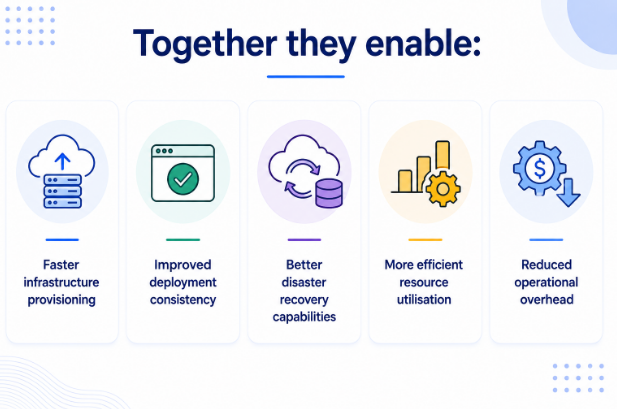
Together they enable:
- Faster infrastructure provisioning
- Improved deployment consistency
- Better disaster recovery capabilities
- More efficient resource utilisation
- Reduced operational overhead
Organizations pursuing cloud initiatives without strong DevOps foundations often struggle to realize the expected business value.
DevOps Drives Business Outcomes
Successful DevOps practices are results-driven and not technology-driven.
While technologies evolve, several DevOps best practices remain consistent, which drive business outcomes:
Automate repetitive tasks.
Manual tasks can lead to inefficiencies and errors.
DevOps automation helps reduce operational overhead while improving consistency across environments.
Build observability into systems
Monitoring should produce actionable insights and not just trigger alerts.
Effective observability helps resolve problems before they cause customer dissatisfaction.
Establish collective ownership
Improvements in software quality require accountability from all stakeholders.
Collective accountability fosters coordination among delivery teams.
Prioritise continuous improvement
DevOps is not a one-time initiative.
High-performing organizations continuously refine workflows, processes, and delivery practices.
Agile DevOps Methodology Improves Responsiveness
Many organizations combine agile development approaches with DevOps practices.
The agile DevOps methodology supports faster feedback loops by connecting software development directly with deployment and operational management.
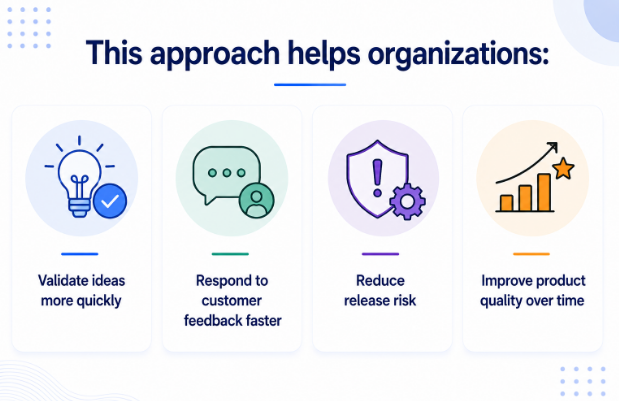
This approach helps organizations:
- Validate ideas more quickly
- Respond to customer feedback faster
- Reduce release risk
- Improve product quality over time
The combination of agile planning and DevOps execution creates a more adaptive operating model.
In rapidly changing markets, adaptability often becomes a competitive advantage.
DevOps Modernization Is Driving Digital Transformation
Many digital transformation initiatives focus heavily on technology upgrades.
Applications are migrated. Infrastructure is modernized. New platforms are introduced.
Yet transformation efforts frequently stall because delivery processes remain unchanged.
DevOps modernization addresses this gap.
Modernization succeeds when organizations improve both technology and operational execution.
That is why DevOps becomes an important part of more extensive service projects related to digital transformation services. The impact of technology investments is greater if they are accompanied by optimized delivery procedures and governance mechanisms.
Workflow Optimization Boosts Operational Efficiency
The software delivery process involves hundreds of actions from planning, coding, testing, deployment, and support.
Even minor delays can snowball into substantial lags.
DevOps workflow optimization aids companies in identifying bottlenecks and removing unnecessary friction from the delivery lifecycle.
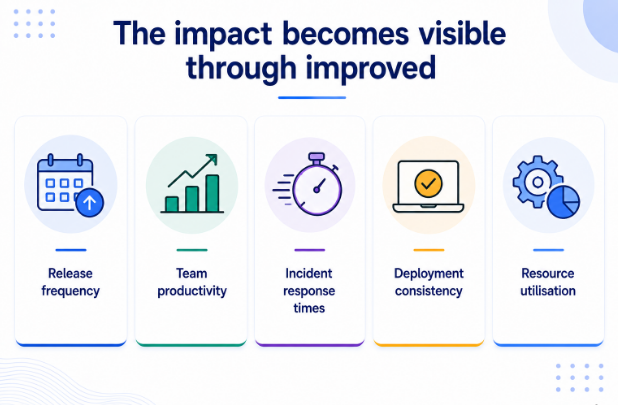
The impact becomes visible through improved
- Release frequency
- Team productivity
- Incident response times
- Deployment consistency
- Resource utilisation
These improvements contribute directly to stronger DevOps operational efficiency.
Continuous Delivery Pipelines Enable Innovation
Innovation depends on execution.
An idea is worth nothing until it has reached the customer.
A mature continuous delivery pipeline facilitates the process of delivering changes into production faster and with more assurance.
Teams develop a system that does not treat releases as high-risk events but instead use automation to deploy changes consistently.
The ability to do so means that businesses can:
- Launch features faster
- Test assumptions earlier
- Respond to market feedback more quickly
- Reduce release-related risk
The ability to innovate consistently often becomes a significant competitive advantage.
DevOps Across the Growth Curve
The principles behind DevOps for startups and enterprises are similar, even though the operational priorities look very different.
DevOps principles are size-agnostic.
For startups, they enable the velocity needed for rapid experimentation and scaling.
For large enterprises, they provide the governance and consistency required to manage legacy complexity.
Regardless of headcount, the objective is identical: building a delivery system that facilitates growth rather than obstructing it.
This is why DevOps remains essential throughout every stage of growth because delivery should never be a bottleneck.
A startup relies on it for raw speed and experimentation, while a global enterprise uses it to maintain consistency across sprawling legacy systems.
Though specific tactics evolve, the core objective is constant: building a resilient delivery engine that scales without increasing technical friction.
Long-term competitive advantage often comes down to this ability to ship software reliably. whether you’re iterating on a new SaaS product or modernizing massive enterprise infrastructure.
The Strategic Shift in Software Delivery
The current pace of software development is effectively outstripping what traditional delivery models can handle.
Between the complexity of AI integration and the constant shift toward cloud-native architectures, technical delivery has moved from being a back-office function to a primary boardroom concern.
As a result, enterprise software delivery is becoming a strategic capability rather than a technical function. This balance is where the real competitive edge lies. Ultimately, a mature DevOps strategy provides the operational structure needed to ensure that high-velocity shipping stays predictable and resilient rather than chaotic.
For organizations trying to modernize delivery without disrupting existing operations, a focused DevOps consulting service can help identify bottlenecks, improve release processes, and build a more resilient operating model.
Closing Thoughts

A modern DevOps business strategy has outgrown the engineering department to become a foundational business concern.
It now directly dictates a company’s capacity to scale, manage operational risk, and pivot. At this stage, a company’s ability to scale or pivot without hitting a wall is directly tied to its delivery strategy.
As software becomes the core of business performance, the real challenge is building a model that supports high velocity without constantly trading off on system health.
It usually comes down to who has built the most resilient framework that actually lets a team pivot without the infrastructure feeling brittle.